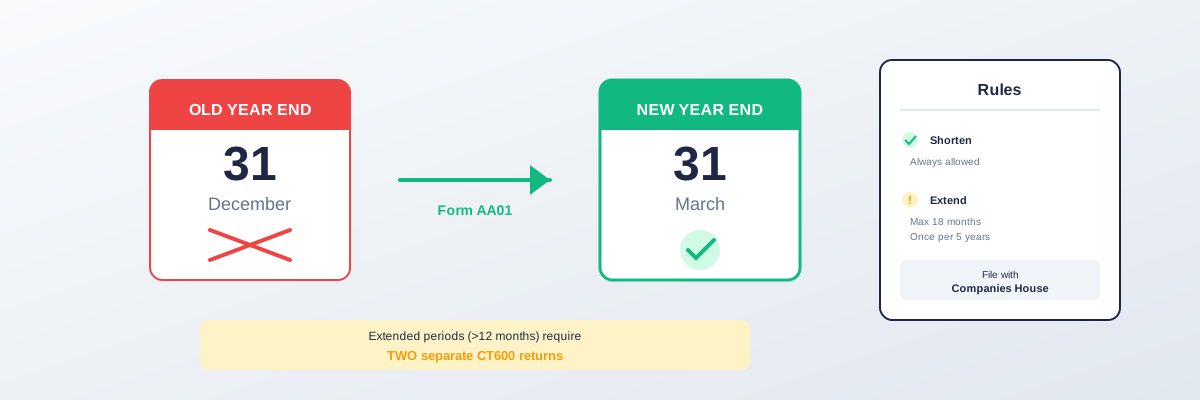
Change Your Accounting Period: Complete Guide
Companies can change their accounting period (financial year end) with Companies House. This guide explains when you can change, how to do it, and the tax implications.
Why Change Your Accounting Period?
Common Reasons
| Reason | Example |
|---|---|
| Align with group | Parent company has March year-end |
| Seasonal business | End after busy season |
| Tax planning | Defer profits to new tax year |
| Cash flow | Match filing deadlines to cash availability |
| Calendar alignment | Move to 31 December |
Popular Year-Ends
| Date | Why |
|---|---|
| 31 March | Aligns with UK tax year |
| 31 December | Calendar year-end |
| 30 September | Six months from tax year |
| 30 April | First month of tax year |
The Rules
Shortening Your Period
Generally unrestricted:
- Can shorten as many times as you want
- No minimum length (but practically needs to be accountable)
- Takes effect immediately
Extending Your Period
Restricted:
- Maximum 18 months from start of current period
- Can only extend once every 5 years
- Exceptions exist (see below)
Exceptions Allowing Multiple Extensions
You can extend more than once in 5 years if:
- Company is in administration
- Secretary of State grants permission
- To align with a subsidiary's year-end (EEA companies)
How to Change Your Accounting Period
Step 1: Check Eligibility
For shortening: Always allowed.
For extending:
- Has company extended in last 5 years?
- Will new period exceed 18 months?
- Is there a valid exception?
Step 2: File Form AA01
Online (recommended):
- Go to Companies House WebFiling
- Sign in
- Select "Change accounting reference date"
- Enter new date
- Specify if shortening or extending
- Submit
- Download form AA01
- Complete and post to Companies House
- Takes longer to process
Step 3: Update Your Records
After approval:
- Update accounting software
- Inform your accountant
- Note new filing deadlines
- Adjust tax payment dates
Impact on Filing Deadlines
Accounts Deadline
| Scenario | Deadline |
|---|---|
| Normal (12 months) | 9 months after period end |
| Shortened period | 9 months after NEW period end (or original deadline if sooner) |
| Extended period | 9 months after NEW period end |
Example: Shortening
Original period: 1 April 2024 - 31 March 2025 Shortened to: 1 April 2024 - 31 December 2024
Accounts due: 30 September 2025 (9 months from 31 Dec)
Example: Extending
Original period: 1 April 2024 - 31 March 2025 Extended to: 1 April 2024 - 30 June 2025
Accounts due: 31 March 2026 (9 months from 30 June)
Tax Implications
Corporation Tax Periods
HMRC doesn't allow tax periods over 12 months. If your accounting period exceeds 12 months:
- Two CT600 returns required
- First 12 months = one return
- Remaining months = second return
- Different tax rates may apply to each
Example: 15-Month Period
Accounting period: 1 January 2024 - 31 March 2025 (15 months)
CT600 returns:
- 1 January 2024 - 31 December 2024 (12 months)
- 1 January 2025 - 31 March 2025 (3 months)
Tax Payment Deadlines
| Period Length | Payment Due |
|---|---|
| 12 months or less | 9 months + 1 day after period end |
| Over 12 months | Two deadlines (one per CT600) |
Profit Apportionment
Extended periods require profit splitting:
Total profit: £90,000 over 15 months
| Period | Days | Apportioned Profit |
|---|---|---|
| First 12 months | 366 | £72,000 |
| Remaining 3 months | 90 | £18,000 |
Planning Considerations
Tax Rate Changes
If tax rates change between periods:
Example: Rate increases on 1 April 2024
- Profits before: lower rate
- Profits after: higher rate
Loss Utilisation
- Losses can only offset profits in same accounting period (for carry-back)
- Changing periods may affect loss relief timing
Associated Companies
The marginal relief thresholds are divided by the number of associated companies. Changing periods might:
- Alter which thresholds apply
- Change effective tax rate
Practical Examples
Scenario 1: Aligning with Tax Year
Company: Currently has 31 December year-end Goal: Move to 31 March
Option A - Extend (if eligible):
- Current: 1 Jan 2024 - 31 Dec 2024
- Extend to: 1 Jan 2024 - 31 Mar 2025 (15 months)
- Future: 1 Apr 2025 - 31 Mar 2026 (normal)
- Current: 1 Jan 2024 - 31 Dec 2024
- Keep as-is
- Next: 1 Jan 2025 - 31 Mar 2025 (3 months)
- Future: 1 Apr 2025 - 31 Mar 2026 (normal)
Scenario 2: First Year Company
Incorporated: 15 June 2024 Default year-end: 30 June 2025
To change to 31 March:
- Shorten to: 15 Jun 2024 - 31 Mar 2025 (9.5 months)
- Future: 1 Apr 2025 - 31 Mar 2026
Common Questions
Can I change before filing first accounts?
Yes. New companies often change their accounting reference date before filing their first accounts.
What if I miss the deadline to change?
You can only change your ARD for a period if:
- Accounts for that period haven't been filed, AND
- The period hasn't already expired
Does changing affect audit requirements?
The audit threshold (£10.2m turnover) is annual. A short period is compared proportionally:
9-month period turnover limit: £10.2m × 9/12 = £7.65m
Can I avoid extended period tax complexity?
Yes—shorten instead of extend:
Instead of one 15-month period, have:
- 12-month period (one CT600)
- 3-month period (one CT600)
Summary
| Action | Key Points |
|---|---|
| Shortening | Unrestricted, takes effect immediately |
| Extending | Max 18 months, once per 5 years |
| Tax returns | Max 12 months each, split if needed |
| File with | Companies House form AA01 |
| Deadline impact | 9 months from NEW period end |
Related guides:
- Extended Accounting Period Guide
- CT600 Filing Deadlines