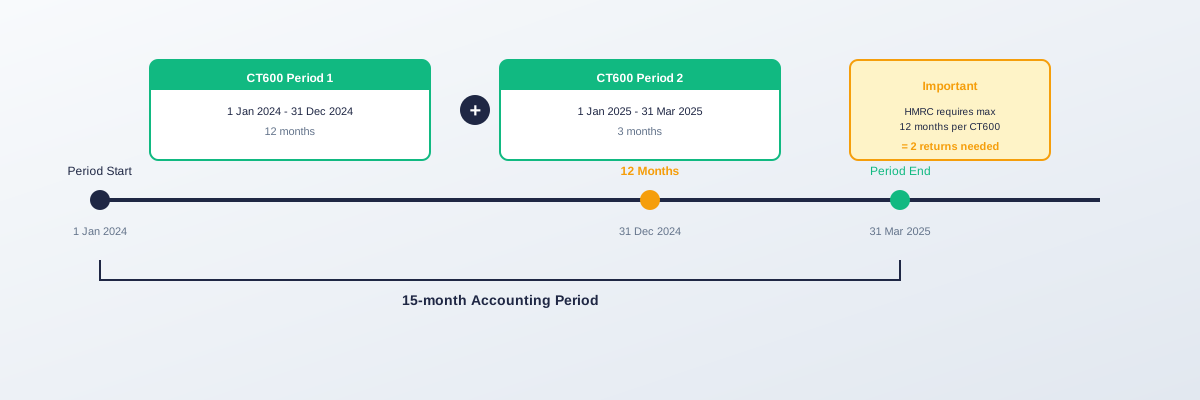
Extended Accounting Periods: Filing Two CT600s
If your accounting period exceeds 12 months, you must file two CT600 returns. This commonly happens in a company's first year. Here's how to handle it correctly.
Why Two CT600s?
HMRC's 12-Month Rule
HMRC calculates corporation tax in periods of no more than 12 months. Even if your company accounts cover a longer period, you must split the tax return.
| Your Accounts | CT600s Required |
|---|---|
| 12 months or less | One |
| Over 12 months | Two |
| Maximum allowed | 18 months |
When This Happens
Most common: First-year companies
Example: Company incorporated 1 June 2024 with year-end 31 March 2025
- Accounting period: 10 months (one CT600)
- Accounting period: 18 months (two CT600s)
How to Split the Period
The Split
| CT600 | Period | Length |
|---|---|---|
| First | Start to +12 months | 12 months |
| Second | +12 months to end | Remainder |
Example: 18-Month Period
Company: Incorporated 1 October 2023 Year-end: 31 March 2025 Total period: 18 months
| CT600 | Period | Length |
|---|---|---|
| First | 1 Oct 2023 - 30 Sep 2024 | 12 months |
| Second | 1 Oct 2024 - 31 Mar 2025 | 6 months |
Splitting Profits
Time Apportionment
Most items are split based on time:
Formula: (Months in period / Total months) × Amount
Example Calculation
Total profit: £36,000 over 18 months
| CT600 | Months | Share | Profit |
|---|---|---|---|
| First | 12 | 12/18 = 66.67% | £24,000 |
| Second | 6 | 6/18 = 33.33% | £12,000 |
Items That Aren't Time-Apportioned
Some items are allocated to specific periods:
| Item | Allocation |
|---|---|
| Capital allowances | Calculated per period |
| Disposals | Period when sold |
| One-off receipts | Period when received |
| Losses | Calculated per period |
Capital Allowances
Special Treatment
Capital allowances are calculated separately for each CT600 period, not split from a total.
AIA Limit
The £1,000,000 Annual Investment Allowance is reduced proportionally:
| Period Length | AIA Available |
|---|---|
| 12 months | £1,000,000 |
| 6 months | £500,000 |
| 9 months | £750,000 |
Example
Equipment purchased: £50,000 in month 8 of 18-month period
This falls in the first CT600 period (months 1-12), so:
- First CT600: Claim £50,000 AIA
- Second CT600: No capital allowances on this item
Filing Deadlines
Two Separate Deadlines
Each CT600 has its own 12-month filing deadline from the end of its period.
Example
Periods:
- First: 1 Oct 2023 - 30 Sep 2024
- Second: 1 Oct 2024 - 31 Mar 2025
| CT600 | Period End | Filing Deadline |
|---|---|---|
| First | 30 Sep 2024 | 30 Sep 2025 |
| Second | 31 Mar 2025 | 31 Mar 2026 |
Payment Deadlines
Corporation Tax Payment
Tax is due 9 months + 1 day after each period end.
| CT600 | Period End | Payment Deadline |
|---|---|---|
| First | 30 Sep 2024 | 1 Jul 2025 |
| Second | 31 Mar 2025 | 1 Jan 2026 |
Companies House Accounts
Single Set of Accounts
Unlike HMRC, Companies House accepts one set of accounts covering the full period (up to 18 months for first accounts).
| Body | What They Accept |
|---|---|
| Companies House | 18-month accounts |
| HMRC | Two separate CT600s |
What to Submit
- To Companies House: One set of accounts (full period)
- To HMRC: Two CT600s with accounts for first period attached
Using Software
How TinyTax Handles This
Good CT600 software:
- Detects extended periods automatically
- Calculates the split
- Apportions profits correctly
- Generates two CT600s
- Creates accounts for the first period
- Submits both to HMRC
Marginal Relief Complications
Separate Calculations
Marginal relief is calculated separately for each period with adjusted thresholds.
Threshold Adjustment
For a period less than 12 months:
| Threshold | Full Year | 6 Months |
|---|---|---|
| Lower limit | £50,000 | £25,000 |
| Upper limit | £250,000 | £125,000 |
Example
Second period: 6 months, profit £40,000
| Threshold | Amount |
|---|---|
| Lower (adjusted) | £25,000 |
| Upper (adjusted) | £125,000 |
| Profit | £40,000 |
| Rate | Marginal relief zone |
Common Mistakes
Mistake 1: Filing One CT600
Filing a single CT600 for an extended period will be rejected.
Mistake 2: Wrong Period Dates
The first period must be exactly 12 months (unless the total is less than 12 months).
Mistake 3: Incorrect Profit Split
Using wrong apportionment percentages, especially for items that should be allocated specifically.
Mistake 4: Missing First Deadline
The first CT600 deadline is earlier than many expect. Don't assume both are due together.
Mistake 5: AIA Miscalculation
Not reducing the AIA limit for shorter periods.
Frequently Asked Questions
Can I choose how to split profits?
No. Time apportionment is mandatory for most items. The split follows the actual periods.
What if I have a loss?
Losses are also split. Each period may show profit or loss independently.
Do I file both CT600s at once?
You can, but they have separate deadlines. Many companies file when accounts are prepared.
What about the balance sheet?
The balance sheet at the end of the first period is needed for that CT600. Software usually generates this.
Is this permanent?
No. Once you reach your first normal year-end, subsequent periods will be 12 months (one CT600).
Summary
| Aspect | First CT600 | Second CT600 |
|---|---|---|
| Period | First 12 months | Remainder |
| Profit split | 12/total months | Remaining/total |
| AIA | Full (£1m) | Proportional |
| Filing deadline | 12m after period 1 end | 12m after period 2 end |
| Payment deadline | 9m+1d after period 1 | 9m+1d after period 2 |
Related guides:
- CT600 Filing Guide
- First CT600 Return