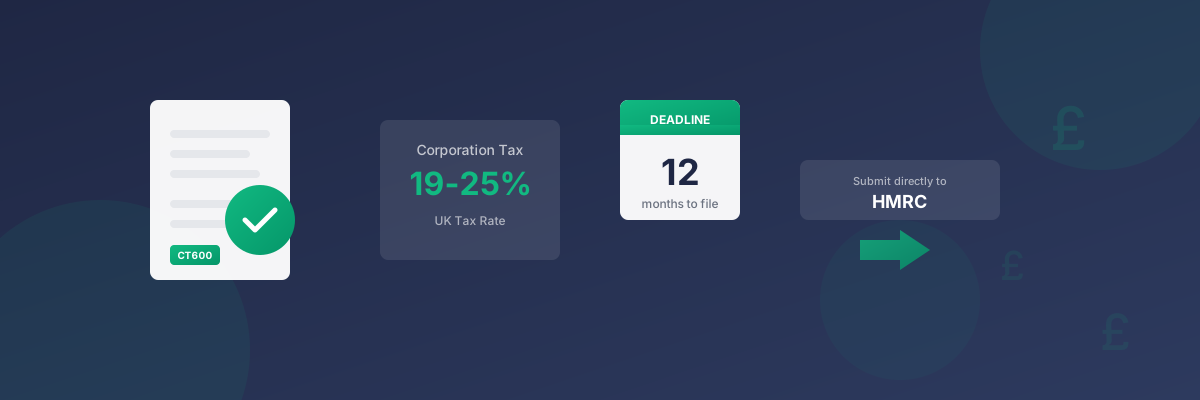
Every UK limited company must file a CT600 corporation tax return with HMRC, regardless of whether the company made a profit or loss. This comprehensive guide covers everything you need to know about the CT600 form, from understanding what it is to successfully submitting your return online.
What Is a CT600?
The CT600 is the official form used by UK limited companies to report their taxable profits and calculate their corporation tax liability to HMRC (Her Majesty's Revenue and Customs). Even dormant companies with no trading activity must file a CT600, though they can often submit a simplified version.
The CT600 captures key financial information including:
- Total turnover and income
- Allowable business expenses
- Capital allowances claimed
- Trading profits or losses
- Any other income (investments, property, etc.)
- Corporation tax calculation
Who Needs to File a CT600?
All UK limited companies registered with Companies House must file a CT600, including:
- Trading companies - Actively conducting business
- Dormant companies - Not trading but still registered
- Property companies - Generating rental income
- Holding companies - Owning shares in subsidiaries
- Companies with investment income - Even without trading
CT600 Deadlines
Understanding your CT600 deadlines is crucial to avoid penalties. There are two key dates to remember:
Filing Deadline
Your CT600 must be filed within 12 months of the end of your accounting period. For example, if your accounting period ends on 31 March 2025, your CT600 is due by 31 March 2026.
Payment Deadline
Corporation tax must be paid within 9 months and 1 day of the accounting period end. Using the same example, payment would be due by 1 January 2026.
Note that the payment deadline comes before the filing deadline. You should calculate and pay your tax liability even before submitting the return.
Corporation Tax Rates
From April 2023, the UK corporation tax rate depends on your company's profits:
- Small profits rate (19%) - For companies with profits up to £50,000
- Main rate (25%) - For companies with profits over £250,000
- Marginal relief - For profits between £50,000 and £250,000
What You Need Before Filing
Before starting your CT600, gather these essential documents:
Financial Records
- Final accounts - Balance sheet and profit & loss statement
- Trial balance - List of all account balances
- Bank statements - To verify transactions
- Sales and purchase invoices - Supporting documentation
Company Information
- Company UTR - Your Unique Taxpayer Reference from HMRC
- Company registration number - From Companies House
- Accounting period dates - Start and end dates
- Previous CT600 - If not your first filing, for comparison
Tax Calculations
- Capital allowances schedule - For equipment, vehicles, etc.
- Disallowable expenses list - Entertainment, fines, depreciation
- Loss memorandum - If carrying forward previous losses
How to File Your CT600 Online
Filing your CT600 online is the standard method accepted by HMRC. Here's a step-by-step guide:
Step 1: Set Up Government Gateway
You'll need a Government Gateway account linked to your company. This requires:
- Your company UTR number
- Company registration number
- A Government Gateway user ID and password
- Activation code (sent by post, takes about 10 days)
Step 2: Prepare Your Computations
Your CT600 must be accompanied by tax computations that show how you arrived at your taxable profit. These typically include:
- Adjustment of accounting profit to taxable profit
- Capital allowances calculation
- Any reliefs claimed (R&D, losses, etc.)
Step 3: Prepare Your Accounts
Your statutory accounts must be filed with the CT600 in iXBRL format. Micro-entities can file abbreviated accounts, while larger companies need full accounts.
Step 4: Complete the CT600 Form
The CT600 has numerous boxes covering different aspects of your company's tax position. Key sections include:
- Company information - Basic details and accounting period
- Income - Trading profits, investment income, property income
- Deductions - Losses, group relief, charitable donations
- Tax calculation - The actual corporation tax computation
- Tax already paid - Payments on account, tax deducted at source
Step 5: Submit Online
Once complete, submit your CT600 along with:
- iXBRL accounts
- iXBRL tax computations
- Any supplementary pages required
Common CT600 Mistakes to Avoid
Many companies make errors that can trigger HMRC enquiries or result in incorrect tax payments. Here are the most common CT600 mistakes:
1. Wrong Accounting Period Dates
Ensure your CT600 covers exactly the right period. New companies often confuse their first accounting period, which may be longer than 12 months.
2. Missing Disallowable Expenses
Certain expenses aren't tax-deductible even though they appear in your accounts:
- Client entertainment
- Depreciation (replaced by capital allowances)
- Fines and penalties
- Personal expenses
3. Incorrect Capital Allowances
Capital allowances replace accounting depreciation for tax purposes. Common errors include:
- Claiming on non-qualifying assets
- Using wrong rates
- Missing the Annual Investment Allowance
4. Forgetting Prior Year Adjustments
If your previous year's accounts were adjusted, ensure your CT600 opening figures match the amended closing figures.
5. Not Claiming All Reliefs
Companies often miss legitimate tax reliefs:
- R&D tax credits for qualifying expenditure
- Loss relief against other income or carried forward
- Group relief where applicable
CT600 Late Filing Penalties
Missing your CT600 deadline results in automatic late filing penalties:
| Time Late | Penalty |
|---|---|
| 1 day late | £100 |
| 3 months late | Additional £100 |
| 6 months late | 10% of unpaid tax (minimum £300) |
| 12 months late | Additional 10% of unpaid tax |
Additionally, late payment of corporation tax incurs interest charges from the due date until payment.
Extended Accounting Periods
If your accounting period exceeds 12 months (common for new companies or when changing year-end), you must file two CT600 returns:
- First period - Covers the first 12 months
- Second period - Covers the remaining months
Dormant Company CT600
Even dormant companies must file CT600 returns, though the process is simpler:
- No trading figures to report
- No tax computation needed
- Can often be filed as a 'nil' return
- Still subject to the same deadlines and penalties
Amending Your CT600
Made a mistake? You can amend your CT600 within 12 months of the filing deadline. After that, you'll need to contact HMRC directly to request a correction.
Common reasons for amendments:
- Discovered errors in calculations
- Missed claiming allowances or reliefs
- Accounting adjustments
- HMRC queries requiring clarification
Filing with TinyTax
TinyTax simplifies CT600 filing for UK micro-entities:
- Automatic calculations - Enter your figures, we calculate the tax
- iXBRL generation - Accounts and computations in the correct format
- Direct submission - File straight to HMRC Government Gateway
- Prior year import - Fetch last year's data automatically
- Extended period handling - Automatic splitting when required
Frequently Asked Questions
How long does it take to file a CT600?
With all your information ready, filing a CT600 through TinyTax typically takes 30-60 minutes. Complex situations with multiple income sources or reliefs may take longer.
Can I file a CT600 myself without an accountant?
Yes, many directors of micro-entities successfully file their own CT600. However, if your affairs are complex or you're uncertain about tax reliefs, professional advice is recommended.
What happens if my CT600 is rejected?
HMRC may reject your CT600 for technical errors (wrong format, validation failures) or data issues. You'll receive an error message explaining the problem. Fix the issue and resubmit promptly to avoid late filing penalties.
Do I need to file a CT600 if I made a loss?
Yes. Even loss-making companies must file a CT600. Reporting your loss correctly allows you to carry it forward against future profits or potentially claim group relief.
When should I pay corporation tax?
Corporation tax is due 9 months and 1 day after your accounting period ends. For large companies (profits over £1.5 million), quarterly instalment payments may be required.
Can I change my company's accounting period?
Yes, but there are restrictions. You can shorten a period at any time, but can only extend it in limited circumstances. Changes must be filed with both Companies House and HMRC.
Next Steps
Ready to file your CT600? Here's how to get started:
- Gather your documents - Accounts, trial balance, company details
- Check your deadlines - Know when your return and payment are due
- Search for your company on TinyTax
- Follow the guided process - We'll walk you through each step
- Submit to HMRC - Direct filing through Government Gateway