Marginal Relief for Corporation Tax: How It Works
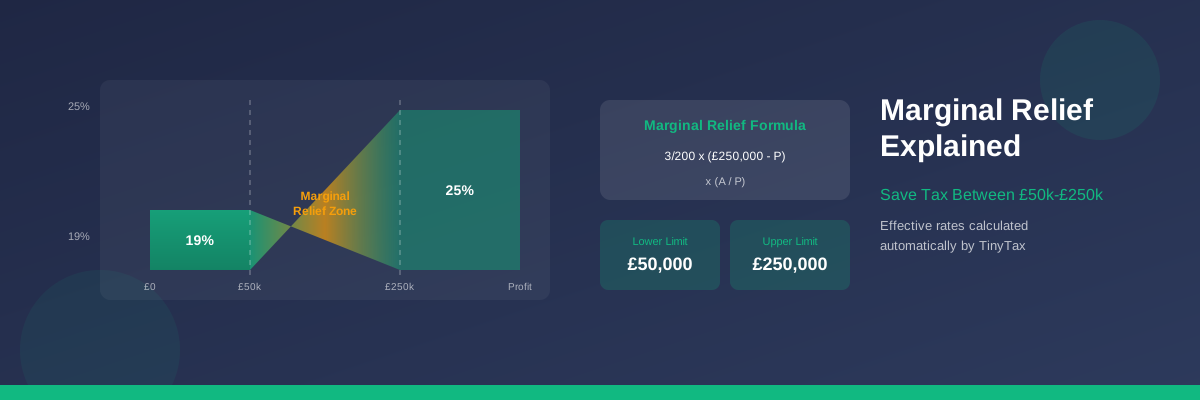
If your company's profits fall between £50,000 and £250,000, you may benefit from marginal relief. This reduces your effective corporation tax rate, easing the transition from the 19% small profits rate to the 25% main rate.
Here is everything you need to know about how marginal relief works and how much you could save.
What Is Marginal Relief?
Marginal relief is a tax reduction for companies whose profits fall between the small profits threshold (£50,000) and the main rate threshold (£250,000).
Without marginal relief, a company earning £50,001 would suddenly pay 25% tax instead of 19% - a cliff edge that would penalise growth. Marginal relief smooths this transition.
The Corporation Tax Rates
From April 2023, UK corporation tax rates are:
| Profit Level | Tax Rate |
|---|---|
| Up to £50,000 | 19% (small profits rate) |
| £50,001 to £250,000 | 19-25% (marginal relief applies) |
| Over £250,000 | 25% (main rate) |
How Marginal Relief Is Calculated
The marginal relief formula is:
Marginal Relief = 3/200 x (Upper Limit - Profits) x (Taxable Profits / Profits)
Where:
- Upper Limit = £250,000
- Profits = Total taxable profits plus franked investment income
- Taxable Profits = Profits actually subject to corporation tax
Simplified Calculation
For most companies without investment income, the formula simplifies to:
Marginal Relief = 3/200 x (£250,000 - Profits)
Or equivalently:
Marginal Relief = (£250,000 - Profits) x 1.5%
Example Calculations
Example 1: Profits of £100,000
- Tax at main rate: £100,000 x 25% = £25,000
- Marginal relief: (£250,000 - £100,000) x 1.5% = £2,250
- Final tax: £25,000 - £2,250 = £22,750
- Effective rate: 22.75%
Example 2: Profits of £150,000
- Tax at main rate: £150,000 x 25% = £37,500
- Marginal relief: (£250,000 - £150,000) x 1.5% = £1,500
- Final tax: £37,500 - £1,500 = £36,000
- Effective rate: 24%
Example 3: Profits of £75,000
- Tax at main rate: £75,000 x 25% = £18,750
- Marginal relief: (£250,000 - £75,000) x 1.5% = £2,625
- Final tax: £18,750 - £2,625 = £16,125
- Effective rate: 21.5%
Effective Tax Rates at Different Profit Levels
| Profit | Tax Before Relief | Marginal Relief | Tax After Relief | Effective Rate |
|---|---|---|---|---|
| £50,000 | £12,500 | £3,000 | £9,500 | 19.00% |
| £75,000 | £18,750 | £2,625 | £16,125 | 21.50% |
| £100,000 | £25,000 | £2,250 | £22,750 | 22.75% |
| £125,000 | £31,250 | £1,875 | £29,375 | 23.50% |
| £150,000 | £37,500 | £1,500 | £36,000 | 24.00% |
| £175,000 | £43,750 | £1,125 | £42,625 | 24.36% |
| £200,000 | £50,000 | £750 | £49,250 | 24.63% |
| £225,000 | £56,250 | £375 | £55,875 | 24.83% |
| £250,000 | £62,500 | £0 | £62,500 | 25.00% |
The Effective Marginal Rate
Within the marginal relief band, the effective marginal rate on additional profits is actually 26.5% - higher than the main rate.
This means each extra pound of profit between £50,000 and £250,000 is taxed at 26.5% (25% plus loss of 1.5% marginal relief).
This is important for tax planning. Once you pass £250,000, additional profit is taxed at only 25%.
Associated Companies
If your company has associated companies (companies under common control), the thresholds are divided by the number of associated companies plus one.
For example, with one associated company:
- Lower limit: £50,000 / 2 = £25,000
- Upper limit: £250,000 / 2 = £125,000
What Counts as Associated?
A company is associated if:
- One controls the other, OR
- Both are under common control
Dormant companies and companies not carrying on a trade are usually excluded from the count.
Short Accounting Periods
If your accounting period is less than 12 months, the thresholds are reduced proportionally.
For a 6-month period:
- Lower limit: £50,000 x 6/12 = £25,000
- Upper limit: £250,000 x 6/12 = £125,000
Franked Investment Income
If your company receives dividends from non-associated UK companies, this affects the marginal relief calculation.
The dividend income is added to profits for determining which threshold applies, but is not itself taxed (to avoid double taxation).
This can push a company into the marginal relief band or out of it, even though the dividend itself carries no additional tax.
How TinyTax Handles Marginal Relief
TinyTax automatically:
- Calculates your profit level
- Determines if marginal relief applies
- Computes the exact relief amount
- Enters the correct figures on your CT600
- Shows your effective tax rate
Common Questions
Does marginal relief apply to all companies?
Marginal relief only applies to companies with profits between £50,000 and £250,000 (adjusted for associated companies and short periods).
Is marginal relief claimed separately?
No. Marginal relief is calculated automatically and built into your CT600 return. There is no separate claim form.
What if I have investment income?
Dividends from UK companies affect which band you fall into but are not taxed. TinyTax handles this calculation for you.
Can I choose not to claim marginal relief?
No. If you qualify, marginal relief is applied automatically. It would be illogical not to claim it.
Summary
Marginal relief reduces corporation tax for companies with profits between £50,000 and £250,000. The relief smoothly transitions the effective rate from 19% to 25% as profits increase.
The calculation involves a specific formula, but TinyTax handles this automatically when you prepare your CT600 return.