R&D Tax Credits: UK Guide for Small Companies
R&D tax credits can significantly reduce your corporation tax bill or provide a cash payment. This guide explains what qualifies and how to claim.
What Are R&D Tax Credits?
R&D (Research and Development) tax relief rewards companies that invest in innovation. You can claim if you're:
- Seeking an advance in science or technology
- Overcoming technical uncertainty
- Work couldn't be easily solved by a competent professional
The Schemes
For Accounting Periods Starting Before 1 April 2024
| Scheme | For | Benefit |
|---|---|---|
| SME R&D | Small companies | Enhanced deduction or cash credit |
| RDEC | Large companies | Above-the-line credit |
For Accounting Periods Starting On/After 1 April 2024
| Scheme | For | Benefit |
|---|---|---|
| Merged R&D scheme | Most companies | 20% credit (above-the-line) |
| Enhanced R&D Intensive (ERIS) | R&D-intensive SMEs | Higher relief for loss-makers |
Am I Eligible?
Company Requirements
| Requirement | Details |
|---|---|
| UK company | Subject to corporation tax |
| Undertaking R&D | Or subcontracting R&D |
| Own the IP | Rights to exploit results |
Project Requirements
Your project must seek an advance that:
- Wasn't already publicly available
- Couldn't be easily worked out by someone skilled in the field
- Involves technical uncertainty
What Counts as R&D?
Qualifying Activities
| Activity | Example |
|---|---|
| Direct R&D | Developing new software features |
| Supporting R&D | Testing the new features |
| Indirect R&D | Project management of R&D team |
Common Qualifying Areas
Technology/Software:
- New algorithms
- Innovative data processing
- Novel system architectures
- Cybersecurity advances
- New production processes
- Material innovations
- Efficiency improvements (if technically uncertain)
- Novel designs
- Prototype development
- Technical problem-solving
What Doesn't Qualify
| Activity | Why Not |
|---|---|
| Market research | Commercial, not technical |
| Styling/aesthetics | No technical uncertainty |
| Routine quality control | Not advancing science |
| Social science research | Must be science/technology |
| Buying existing solutions | No R&D activity |
Qualifying Costs
Eligible Expenditure
| Cost Type | What's Included |
|---|---|
| Staff costs | Salaries, NI, pension for R&D staff |
| Consumables | Materials used up in R&D |
| Software | Directly used in R&D |
| Subcontractors | External R&D work |
| Externally provided workers | Agency staff on R&D |
| Utilities | Power, water, fuel for R&D |
Staff Costs Calculation
``` Qualifying staff cost = Salary + Employer NI + Pension contributions ```
For part-time R&D work: ``` Qualifying amount = Total cost × % time on R&D ```
Example: Software Developer
Annual salary: £50,000 Employer NI: £5,500 Pension: £1,500 Total cost: £57,000 Time on R&D: 60%
Qualifying cost: £57,000 × 60% = £34,200
How Much Can You Claim?
Merged Scheme (From April 2024)
| Situation | Credit |
|---|---|
| Standard credit | 20% of qualifying spend |
| Above-the-line | Offsets tax, excess payable |
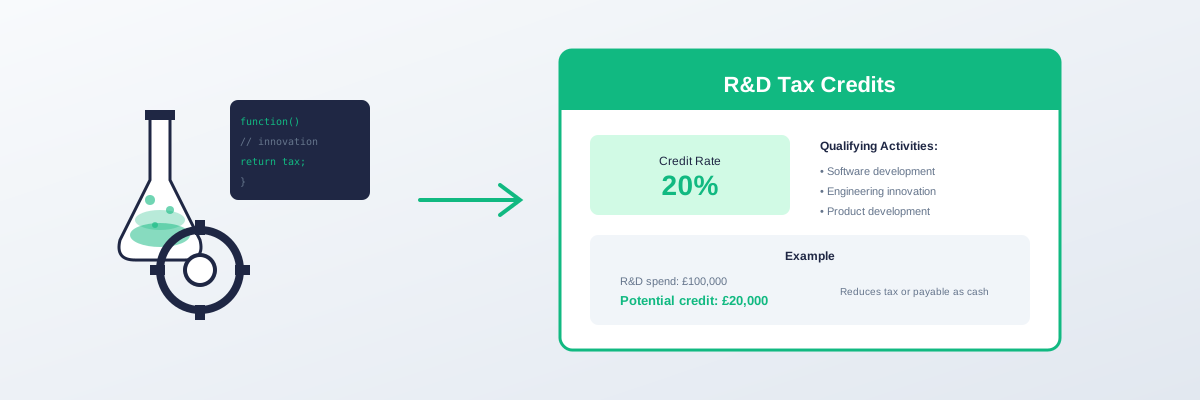
- Qualifying R&D spend: £100,000
- R&D credit: £20,000
- If profit-making: Reduces tax by £20,000
- If loss-making: Can surrender for cash
SME Scheme (Pre-April 2024 Periods)
| Situation | Benefit |
|---|---|
| Profitable | 86% enhanced deduction |
| Loss-making | Up to 18.6% cash credit |
Making a Claim
Through Your CT600
R&D claims are made via your corporation tax return:
- Calculate qualifying expenditure
- Prepare technical narrative
- Complete relevant CT600 boxes
- Submit with supporting documentation
Key CT600 Boxes
| Box | Purpose |
|---|---|
| Box 660 | R&D enhanced expenditure (SME) |
| Box 670 | RDEC tax credit |
| Box 530 | R&D losses surrendered for credit |
Supporting Documentation
Technical report should include:
- Project descriptions
- Technical advances sought
- Uncertainties overcome
- Methodology
- How baseline was established
- Timesheet data (or estimates with basis)
- Cost allocations
- Subcontractor invoices
- Materials used
Common Mistakes
Mistake 1: Not Claiming at All
Many companies don't realise they qualify. If you've solved technical problems, you may have R&D.
Mistake 2: Overclaiming
Claiming routine development or general business costs leads to HMRC enquiries and penalties.
Mistake 3: Poor Documentation
Claims without supporting evidence are vulnerable to challenge. Keep:
- Project records
- Technical documentation
- Time allocation evidence
- Financial backup
Mistake 4: Missing Subcontractor Rules
Pre-April 2024: Subcontracted work typically 65% qualifying Post-April 2024: Different rules for connected/unconnected
Mistake 5: Wrong Scheme
Check which scheme applies to your accounting period. The rules changed significantly in April 2024.
HMRC Compliance
Additional Information Form
Since August 2023, claims must include an Additional Information Form with:
- Senior company officer signoff
- Agent details (if used)
- Contact for HMRC queries
- Project descriptions
HMRC Enquiries
R&D claims face increased scrutiny. Expect:
- Technical questions about projects
- Financial evidence requests
- Time allocation challenges
Frequently Asked Questions
Can a one-person company claim?
Yes, if you're doing qualifying R&D work. Your time spent on R&D counts.
Do I need to succeed for it to count?
No. R&D that fails is still R&D. The attempt matters, not the outcome.
Can I claim for previous years?
Yes, claims can be made for the previous 2 accounting periods (subject to limits).
Do I need a specialist to claim?
Not legally required, but many companies use R&D specialists for:
- Identifying qualifying work
- Preparing technical narratives
- Maximising legitimate claims
- HMRC enquiry support
How long does HMRC take to process?
Standard CT600: 4-6 weeks R&D claims: Often longer, especially first claims or large amounts
Summary
| Aspect | Details |
|---|---|
| Who qualifies | Companies solving technical problems |
| Qualifying costs | Staff, consumables, subcontractors |
| Claim via | CT600 return |
| Documentation | Technical narrative + financial records |
| Current scheme | Merged scheme (20% credit) |
Related guides: