Associated Companies: How They Affect Corporation Tax
If you have more than one company, the "associated companies" rules may affect your corporation tax rate. Associated companies divide the profit thresholds for the small profits rate.
Why Associated Companies Matter
Corporation tax uses tiered rates:
| Profit Level | Rate |
|---|---|
| Up to £50,000 | 19% (small profits) |
| £50,001-£250,000 | 19-25% (marginal relief) |
| Over £250,000 | 25% (main rate) |
How Thresholds Change
| Number of Associates | Lower Limit | Upper Limit |
|---|---|---|
| 0 (standalone) | £50,000 | £250,000 |
| 1 | £25,000 | £125,000 |
| 2 | £16,667 | £83,333 |
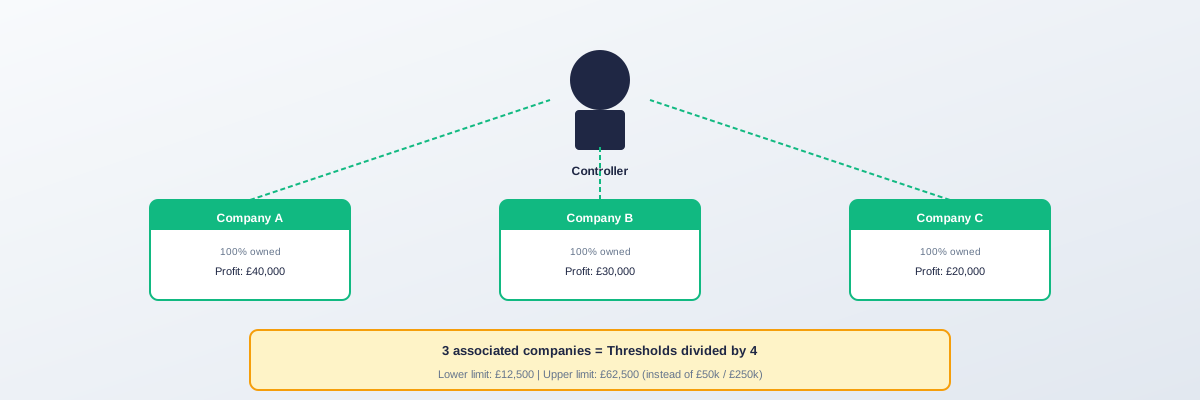
| 3 | £12,500 | £62,500 |
| 4 | £10,000 | £50,000 |
What Makes Companies "Associated"?
The Definition
Two companies are associated if:
- One controls the other, OR
- Both are under common control
Control Means
Having control of:
- More than 50% of ordinary share capital, OR
- More than 50% of voting rights, OR
- Rights to more than 50% of distributable income, OR
- Rights to more than 50% of assets on winding up
Counting Associated Companies
Who Counts
| Counts as Associated | Doesn't Count |
|---|---|
| Companies you control | Companies you have small stakes in |
| Companies controlled by same persons | Companies with different controllers |
| Group companies | Joint ventures (usually) |
The "Same Persons" Test
Companies controlled by the same individual(s) are associated, even if:
- They do different things
- They have no transactions between them
- They have different directors
Example 1: Clear Association
Person A owns:
- Company X: 100%
- Company Y: 100%
Example 2: Multiple Owners
Person A owns:
- Company X: 60%
- Company Y: 60%
Example 3: Not Associated
Person A owns Company X: 100% Person B owns Company Y: 100%
Result: Not associated (different controllers).
Family and Connected Persons
Attribution Rules
Shares held by certain "connected persons" may be attributed to you:
| Connection | Attribution? |
|---|---|
| Spouse/civil partner | Yes |
| Minor children | Yes |
| Business partners | Sometimes |
| Other relatives | Generally no |
| Associates | Sometimes |
Example: Spouse Attribution
You own Company X: 100% Your spouse owns Company Y: 100%
Without attribution: Not associated With attribution: May be associated
Important: Attribution only applies for the associated company test if there's a "substantial commercial interdependence."
Substantial Commercial Interdependence
When It Applies
Attribution only connects family companies if they have:
- Financial interdependence (loans, guarantees)
- Economic interdependence (same customers, suppliers)
- Organisational interdependence (shared management, premises)
Example: Truly Separate
You: Own a web design company Your spouse: Owns a cafe
If there's no commercial connection, attribution may not apply. Seek professional advice.
Dormant Companies
Do They Count?
Yes, but...
A dormant company counts as associated UNLESS:
- It has no assets, OR
- It hasn't carried on a trade since being incorporated
Practical Examples
Example 1: IT Contractor
Situation: You have one company, no others Associates: 0 Lower threshold: £50,000 Upper threshold: £250,000
Example 2: Multiple Businesses
Situation: You own two trading companies Associates: 1 Lower threshold: £25,000 Upper threshold: £125,000
Tax impact: If each company makes £40,000:
- Without association: 19% rate
- With association: Marginal relief zone (higher effective rate)
Example 3: Group Structure
Situation: Parent company + 3 subsidiaries Associates: 3 Lower threshold: £12,500 Upper threshold: £62,500
Impact on Tax
Tax Calculation Example
Without associated companies:
- Profit: £100,000
- Rate: Marginal relief zone
- Effective rate: ~19.4%
- Tax: ~£19,400
- Profit: £100,000
- Rate: Above £125k threshold = closer to 25%
- Effective rate: ~22.8%
- Tax: ~£22,800
Frequently Asked Questions
Do joint ventures count?
Usually not. Joint ventures where no single party has control aren't associated. But check the specific arrangements.
What about companies I'm a director of but don't own?
No association. Being a director doesn't create control.
Do associated companies share the threshold?
No. Each company gets the full (reduced) threshold. The threshold isn't shared between them.
What if associates are overseas?
Overseas companies can count as associated. The test is control, not location.
Does this affect dormant companies?
Dormant companies still count in the number unless they have no assets. Even a company with £100 in the bank counts.
Can I restructure to avoid this?
Potentially, but HMRC has anti-avoidance rules. Any restructuring must have genuine commercial reasons.
Summary
| Factor | Impact |
|---|---|
| What counts | Companies under common control |
| Effect | Thresholds divided by (associates + 1) |
| Family | Attribution rules may apply |
| Dormant | Count unless no assets |
| Planning | Limited—anti-avoidance applies |
Related guides: