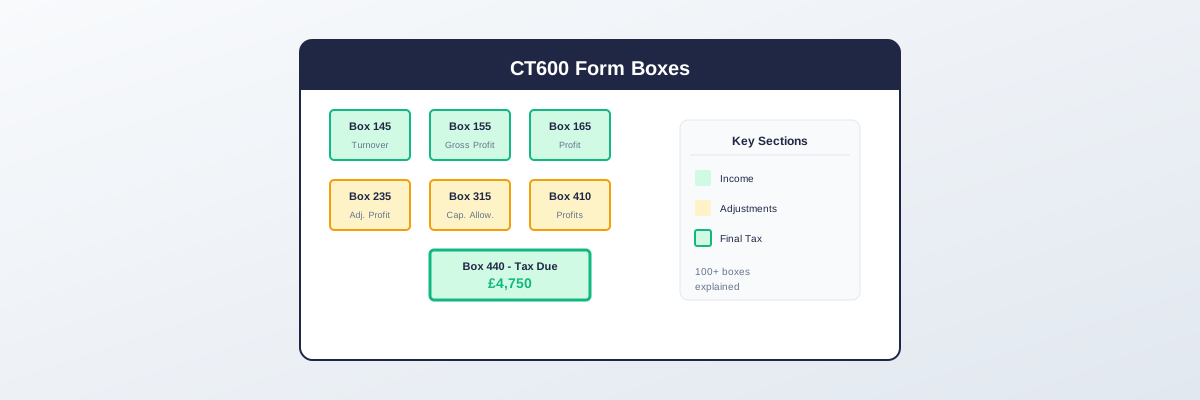
CT600 Boxes Explained: Understanding Every Field
The CT600 form contains over 100 boxes, but most companies only use a fraction of them. This guide explains the key boxes in plain English.
How CT600 Boxes Are Organised
| Box Range | Section |
|---|---|
| 1-45 | Company information |
| 50-95 | Return details |
| 145-195 | Income |
| 235-315 | Deductions and reliefs |
| 330-380 | Losses |
| 400-475 | Tax calculation |
| 520+ | Payments and special situations |
Company Information (Boxes 1-45)
Box 1: Company Name
Your registered company name exactly as shown at Companies House.
Box 3: Company Registration Number
Your 8-digit Companies House number (e.g., 12345678).
Box 4: Tax Reference (UTR)
Your 10-digit Unique Taxpayer Reference from HMRC.
Box 30: Start of Accounting Period
First day of the period covered by this return (DD/MM/YYYY).
Box 35: End of Accounting Period
Last day of the period (DD/MM/YYYY).
Box 40: Type of Company
Select from:
- Trading company
- Investment company
- Property company
- Close investment-holding company
Income Section (Boxes 145-195)
Box 145: Gross Trading Profits
Total trading income before deducting expenses.
What to include:
- Sales revenue
- Service fees
- Commission
- Any trading income
Box 155: Net Trading Profits
Trading profit after deducting allowable expenses.
Calculation: Box 145 minus trading expenses
If this is negative (a loss), leave blank and use Box 160 instead.
Box 160: Trading Losses
If your trading expenses exceed trading income, enter the loss here as a positive number.
Box 165: Net Capital Allowances
Capital allowances claimed against trading profits (AIA, WDA, etc.).
Box 170: Income from Property
Net rental income after property expenses.
Box 172: Non-Trading Income
Interest received, investment returns, and other non-trading income.
Box 190: Total Income
Sum of all income sources. Software calculates this automatically.
Deductions Section (Boxes 235-315)
Box 235: Total Profits Before Deductions
Usually equals Box 190.
Box 275: Trading Losses Used
Brought forward trading losses being used to reduce this period's trading profits.
Box 285: Non-Trade Deficits Used
Losses from non-trading activities (e.g., property losses carried forward).
Box 295: Qualifying Charitable Donations
Donations to registered UK charities made during the period.
Box 315: Profits Chargeable to Corporation Tax
The final taxable profit after all deductions. Your tax is calculated on this amount.
Calculation: Box 235 minus all deduction boxes
Losses Section (Boxes 330-380)
Box 330: Amount of Loss
Total trading loss arising this period (if applicable).
Box 335: Losses Carried Forward
Trading losses you're carrying forward to future periods.
Box 380: Losses Carried Back
Trading losses being claimed against the previous period's profits.
Tax Calculation (Boxes 400-475)
Box 400: Tax Rate
The corporation tax rate being applied.
Box 430: Corporation Tax
Basic tax before any marginal relief.
For profits up to £50,000: Profit × 19% For profits over £250,000: Profit × 25% For profits between £50k-£250k: More complex (marginal relief applies)
Box 435: Marginal Relief
Reduction in tax for companies with profits between £50,000 and £250,000.
Box 440: Corporation Tax After Marginal Relief
Box 430 minus Box 435.
Box 475: Total Tax Payable
Final corporation tax liability for this period.
Associated Companies (Box 625)
Why It Matters
If you have associated companies, the profit thresholds for small profits rate are divided.
| Associates | Lower Threshold | Upper Threshold |
|---|---|---|
| None | £50,000 | £250,000 |
| 1 | £25,000 | £125,000 |
| 2 | £16,667 | £83,333 |
| 4 | £10,000 | £50,000 |
What Counts as Associated?
Companies under common control (same persons control both), including:
- Other companies you own
- Companies owned by your business partners
- Family-controlled companies (in some cases)
Supplementary Pages
For specific situations, additional pages are required:
CT600A - Losses, Deficits and Excess Amounts
Required if:
- Carrying losses forward or back
- Claiming group relief
- Complex loss situations
CT600C - Group and Consortium Relief
Required if claiming or surrendering group relief.
CT600E - Charities and CASCs
For charitable companies and Community Amateur Sports Clubs.
Examples
Example 1: Simple Trading Company
| Box | Description | Amount |
|---|---|---|
| 145 | Gross trading profits | £80,000 |
| 155 | Net trading profits | £25,000 |
| 165 | Capital allowances | £3,000 |
| 190 | Total income | £22,000 |
| 315 | Profits chargeable | £22,000 |
| 430 | CT at 19% | £4,180 |
Example 2: With Property Income
| Box | Description | Amount |
|---|---|---|
| 155 | Net trading profits | £30,000 |
| 170 | Property income | £15,000 |
| 190 | Total income | £45,000 |
| 315 | Profits chargeable | £45,000 |
| 430 | CT at 19% | £8,550 |
Example 3: Marginal Relief Zone
| Box | Description | Amount |
|---|---|---|
| 315 | Profits chargeable | £100,000 |
| 430 | CT at 25% | £25,000 |
| 435 | Marginal relief | (£5,625) |
| 440 | CT payable | £19,375 |
Common Questions by Box
Box 155 vs Box 160
You can't have both. Either you have a profit (Box 155) or a loss (Box 160), never both.
Why is Box 315 Important?
It's the final taxable profit—the number your tax is calculated on. Everything above flows down to this.
What About Box Numbers I Don't Recognise?
Most boxes are for special situations. If you're a simple trading company, you'll only use about 20 boxes.
Using Software
Modern CT600 software:
- Hides irrelevant boxes
- Uses plain English labels
- Calculates totals automatically
- Validates before submission
Quick Reference
| Section | Key Boxes | Purpose |
|---|---|---|
| Company | 1, 3, 4 | Identification |
| Period | 30, 35 | Dates covered |
| Income | 145, 155, 170 | Money coming in |
| Deductions | 275, 295, 315 | Reducing taxable profit |
| Losses | 330, 335, 380 | Using/creating losses |
| Tax | 430, 435, 475 | What you owe |
Related guides: