CT600 Deadlines: When to File Your Corporation Tax Return
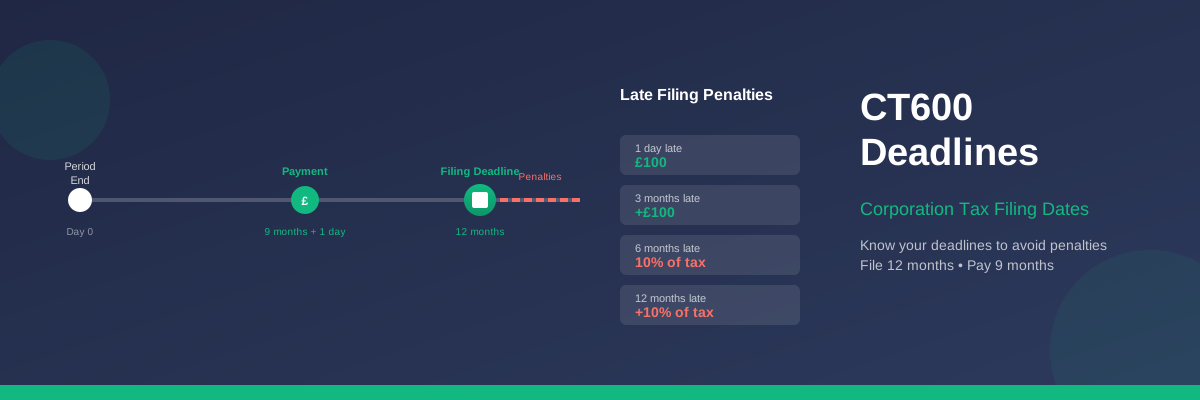
Missing your CT600 deadline triggers automatic penalties from HMRC — starting at £100 and escalating quickly. Understanding your filing and payment deadlines is essential for every UK limited company.
This guide covers everything you need to know about CT600 deadlines, including how to calculate your dates, what happens if you're late, and how to avoid costly penalties.
The Two Key Deadlines
Every company has two separate Corporation Tax deadlines:
| Deadline | When It Falls |
|---|---|
| Filing deadline | 12 months after the accounting period ends |
| Payment deadline | 9 months and 1 day after the accounting period ends |
How to Calculate Your Deadlines
Standard Deadlines
For a company with an accounting period ending on 31 March 2025:
- Payment deadline: 1 January 2026 (9 months + 1 day)
- Filing deadline: 31 March 2026 (12 months)
First Year Deadlines
New companies often have longer first accounting periods. Your first period can be up to 18 months from incorporation, and your filing deadline is the later of:
- 12 months after the accounting period ends, OR
- 3 months after HMRC issues a notice requiring a return
Extended Accounting Periods (Over 12 Months)
If your accounting period exceeds 12 months, you must file two separate CT600 returns:
- First CT600: Covers the first 12 months
- Second CT600: Covers the remaining period (up to 6 months)
| Return | Period Covered | Filing Deadline |
|---|---|---|
| First CT600 | First 12 months | 12 months after first 12 months end |
| Second CT600 | Remaining period | 12 months after remaining period ends |
Example: 18-Month Accounting Period
Company incorporated: 1 January 2024 First accounts period end: 30 June 2025 (18 months)
- First CT600: Covers 1 Jan 2024 – 31 Dec 2024
- Second CT600: Covers 1 Jan 2025 – 30 June 2025
Profits and tax are apportioned between the two periods. TinyTax calculates this automatically and generates both returns.
Late Filing Penalties
HMRC charges escalating penalties for late CT600 filing:
| How Late | Penalty |
|---|---|
| 1 day late | £100 |
| 3 months late | Additional £100 (total £200) |
| 6 months late | 10% of unpaid tax, or £300 — whichever is greater |
| 12 months late | Additional 10% of unpaid tax, or £300 — whichever is greater |
Repeat Offender Surcharge
If you file late three times in a row, the £100 penalties increase to £500 each. This means:
- 1 day late: £500 (instead of £100)
- 3 months late: Additional £500 (instead of £100)
Tax Determination at 6 Months
If you still haven't filed after 6 months, HMRC will issue a tax determination — their estimate of how much Corporation Tax you owe. You cannot appeal this determination; you can only file your actual return to replace it.
Late Payment Penalties and Interest
Late payment attracts interest from day one, plus penalties after 30 days:
Interest
Interest accrues daily from the payment deadline. The current rate is the Bank of England base rate plus 2.5% (approximately 7.5%).
Penalties
| When | Penalty |
|---|---|
| 30 days late | 5% of unpaid tax |
| 6 months late | Additional 5% of unpaid tax |
| 12 months late | Additional 5% of unpaid tax |
- £200+ in filing penalties
- 10-20% of tax in additional filing penalties
- 15% of tax in payment penalties
- Interest on all unpaid amounts
Quarterly Instalment Payments
Large companies (profits over £1.5 million) must pay Corporation Tax in quarterly instalments during the accounting period, not 9 months after it ends.
Instalment dates are:
- 6 months and 13 days after the period starts
- 3 months after the first instalment
- 3 months after the second instalment
- 3 months and 14 days after the period ends
How to Check Your Deadline
HMRC sends a CT603 notice telling you to file a Corporation Tax return. This notice includes your filing deadline.
However, don't rely solely on receiving this notice:
- HMRC may send it late
- It may go to an old address
- You're responsible for knowing your deadline regardless
What If You Can't File on Time?
Unlike Companies House, HMRC does not grant extensions to Corporation Tax filing deadlines. If you can't file on time, you'll face penalties.
However, you can:
File an Estimated Return
If you don't have final figures, you can file a CT600 with estimated amounts and amend it later. This avoids late filing penalties, though you must ensure any tax shown as due is paid.
Claim Reasonable Excuse
HMRC may cancel penalties if you have a "reasonable excuse." This is a high bar:
Usually accepted:
- Serious illness preventing any action
- Death of a key person
- Fire, flood, or theft of records
- HMRC system errors
- Too busy
- Didn't receive reminder
- Relied on agent/accountant
- Cash flow problems
- Didn't know about the deadline
Dormant Company Deadlines
Dormant companies must still file CT600 returns, with the same deadlines as trading companies:
- Filing deadline: 12 months after the accounting period ends
- Payment deadline: N/A (no tax to pay)
Changing Your Accounting Reference Date
You can change your accounting reference date at Companies House, which affects your Corporation Tax deadlines. This is useful for:
- Aligning with a tax-efficient year end
- Matching a parent company's year end
- Managing cash flow
Frequently Asked Questions
What if my deadline falls on a weekend?
HMRC follows the common law rule: if a deadline falls on a weekend or bank holiday, you have until the next working day. However, don't rely on this — file early to avoid any risk.
Can I file before my accounts are finalised?
Yes. You can file a CT600 with provisional figures and amend it later. You have 12 months from the original filing deadline to amend your return.
What if I've never filed and HMRC hasn't contacted me?
You're still required to file. HMRC may not know about your company's existence in their systems, but once they do, they'll chase all outstanding returns with penalties backdated.
Do I need to file if I made no profit?
Yes. Every company must file a CT600, even if it made a loss or broke even. The return confirms your tax position for the period.
How far back can HMRC go?
HMRC can go back up to 20 years if they believe you've deliberately evaded tax. For innocent errors, the limit is usually 4-6 years. Outstanding returns can be demanded indefinitely.
Stay on Top of Your Deadlines
The best way to avoid penalties is to file early. With TinyTax, you can complete your CT600 in minutes — calculate your tax, generate compliant accounts and computations, and submit directly to HMRC.
Don't wait until the last minute. File your CT600 today and get confirmation instantly.